Cash may change hands in seconds, but accepting a counterfeit bill can leave a business paying the price. Once a fake note enters the register, that money has no value, so prevention is essential to protecting revenue.
Training employees to recognize the security features built into U.S. currency is a good first line of defense. For businesses that handle cash frequently or in high volumes, counterfeit detection equipment can add another layer of speed, consistency, and confidence.
What is Counterfeit Money Detection?
Counterfeit money detection is the process of examining currency for security features and characteristics that help determine whether a bill is genuine. Detection can involve manual inspection or equipment that uses technologies such as ultraviolet (UV), magnetic (MG), and infrared (IR) authentication.
Businesses can combine employee training with automated counterfeit-detection equipment to establish a consistent process for checking suspicious bills. The right approach depends on the amount of cash handled, transaction speed, and the organization’s overall cash-management needs.
How Can You Tell if Money Is Counterfeit?
You can help identify counterfeit money by checking a bill’s texture, color-shifting features, watermark, and security thread. The U.S. Currency Education Program recommends a simple approach to authenticating currency: feel, tilt, and check. Genuine U.S. notes include security features that vary by denomination, such as watermarks, security threads, color-shifting ink, and, on the current $100 note, a 3-D security ribbon.
Employees can start by feeling the note. Genuine currency has a distinctive texture and raised printing. They can then tilt the bill to look for color-shifting elements and hold it up to light to check for the watermark and the embedded security thread.
But a busy cashier, teller, or employee may handle hundreds or even thousands of bills during a shift. That’s where automated counterfeit detection can help.
How Do Counterfeit Bill Detectors Work?
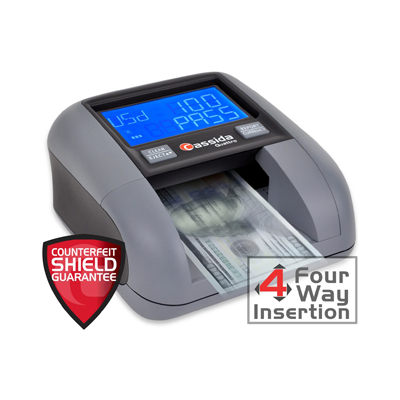
Counterfeit bill detectors work by analyzing the security features and characteristics of genuine currency using technologies such as UV, magnetic, and infrared detection. Depending on the equipment, multiple authentication methods may be used to identify suspicious bills.
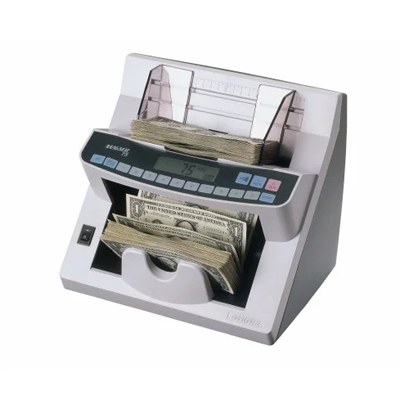
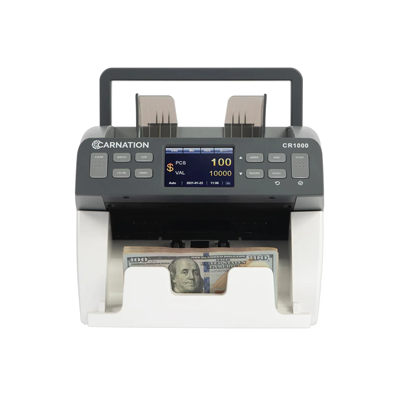
Rather than relying solely on an employee to recognize every security feature, automated equipment can help make authentication a consistent part of the cash-handling process. Some currency counters and discriminators can also authenticate bills during counting or processing, helping businesses combine multiple cash-handling tasks.
What’s the Difference Between UV, Magnetic, and Infrared Counterfeit Detection?
UV, magnetic, and infrared counterfeit detection methods examine different characteristics of genuine currency. Some counterfeit detection equipment combines multiple technologies to provide additional layers of authentication.